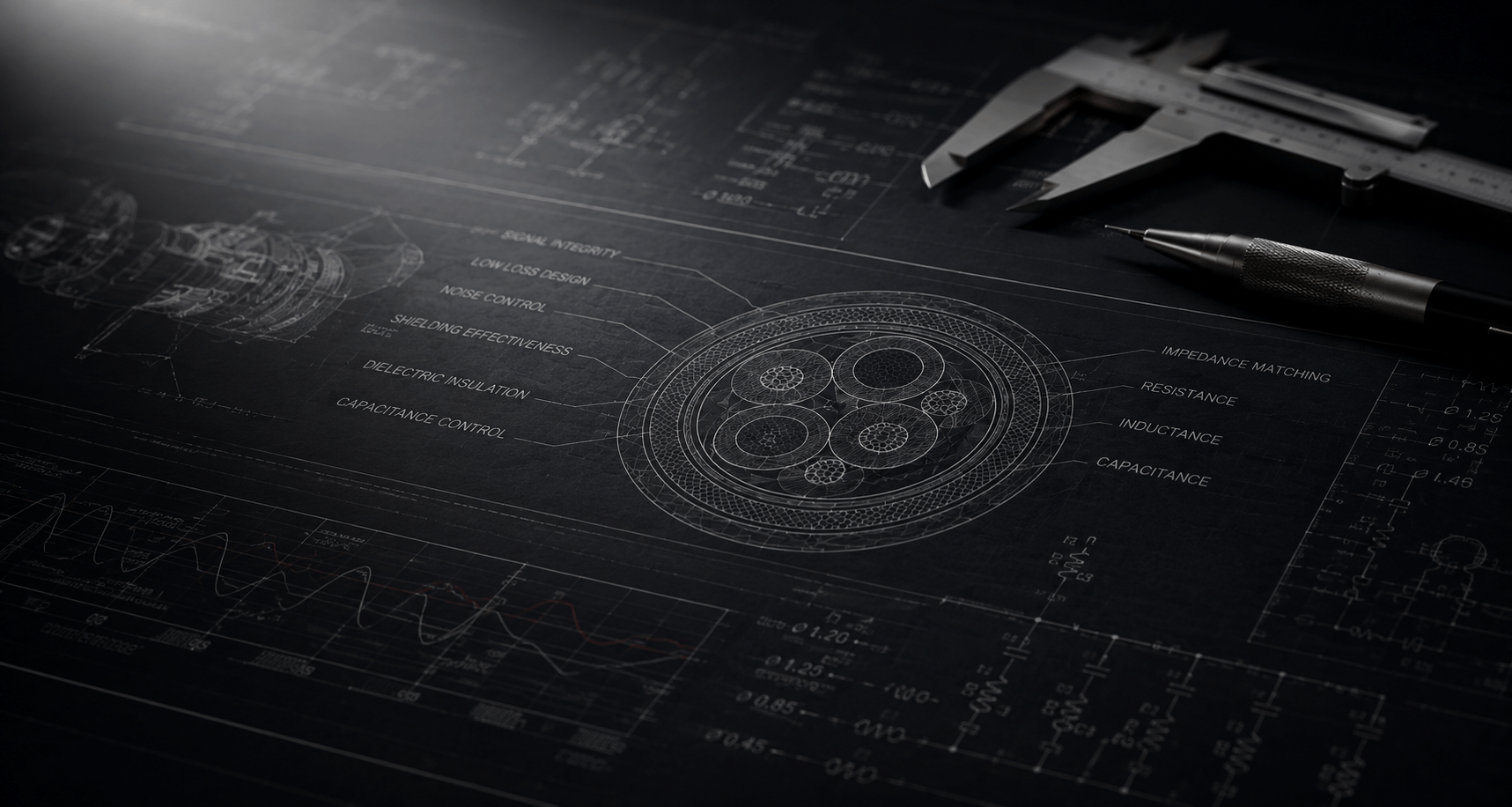
HMS Elektronik cable geometry is engineered to control the electrical relationship between conductors, insulation and shielding, helping optimise resistance, capacitance, inductance and signal integrity.
Why geometry matters
A cable is more than a conductor surrounded by insulation. The way conductors are arranged, spaced, twisted and shielded directly influences the electrical behaviour of the cable.
Resistance, capacitance and inductance are all affected by cable geometry. If these properties are not carefully controlled, the cable can influence timing, dynamics, frequency balance and overall signal stability.
HMS Elektronik designs every cable geometry around measurable electrical principles, ensuring that each construction serves the musical signal rather than altering it.
Controlling the electrical balance
Every HMS Elektronik cable geometry is developed to create a controlled and predictable electrical environment for the signal.
The spacing between conductors, the twisting pattern, the shielding structure and the mechanical damping all influence how the cable behaves in a real audio system. By carefully balancing these factors, HMS Elektronik reduces unwanted electrical interaction and supports stable signal transfer.
For HMS Elektronik, geometry is never chosen for appearance alone. It is a functional engineering decision that works together with conductor quality, insulation and shielding to preserve timing, dynamics and tonal accuracy.
Engineered conductor layout
The position and spacing of every conductor are carefully defined to support stable electrical performance and consistent signal transmission.
Optimised electrical values
Cable geometry helps control resistance, capacitance and inductance, which are essential for preserving timing, dynamics and tonal balance.
Mechanical stability
A stable cable structure helps reduce unwanted movement, vibration and interaction between internal cable elements.
Key benefits of Cable Geometry
Controlled layout
Defines the relationship between conductors to support stable, predictable signal behaviour.
Lower capacitance
Helps preserve speed, openness and low-level detail by reducing unwanted electrical storage.
Stable inductance
Supports consistent current flow and predictable performance across demanding audio systems.
Mechanical control
Maintains cable stability and reduces unwanted interaction between internal cable elements.
Applied across HMS Elektronik cable designs
Cable geometry plays a central role throughout the HMS Elektronik portfolio, from accessible cable ranges to advanced reference designs.
In every series, the conductor layout is matched to the intended application, whether the goal is low capacitance, high current delivery, precise shielding behaviour or maximum signal stability.
The result is a cable design focused on measurable performance, long-term consistency and natural musical realism.
Continue Exploring HMS Elektronik Technology
Cable Geometry is one part of the HMS Elektronik engineering philosophy.
Discover how conductor materials, shielding, insulation and power filtering work together to preserve the musical signal.